

I pit the Anova and Joule head-to-head — here’s why I chose the one that turned my steaks restaurant-worthy in half the time.
Tired of inconsistent results at home, I tested the Anova Precision Cooker and the Joule to compare performance, heating speed, temperature accuracy, ease of use, connectivity and overall value so you can confidently choose the best sous-vide for your kitchen.
Budget Friendly

7.6
I find this unit delivers dependable sous-vide performance at a competitive price and makes it easy to achieve consistent results. The app ecosystem and built-in features are useful, though you may run into connectivity hiccups occasionally.
Compact Precision

9.3
I appreciate how compact and fast this unit is — it heats quickly and keeps temperature extremely steady, which makes cooking foolproof. The app experience is smooth and the unit is impressively quiet, though it comes at a premium price.
Anova AN500 Cooker
- Build Quality – 7.5
- Heating Speed & Accuracy – 8
- App & Connectivity – 7
- Ease of Use & Noise – 8
Joule ChefSteps Wand
- Build Quality – 9.3
- Heating Speed & Accuracy – 9.5
- App & Connectivity – 9
- Ease of Use & Noise – 9.2
Anova AN500 Cooker
Pros
- Strong value for money with broad recipe support
- Solid temperature control for reliable sous-vide results
- Removable clamp and splash-resistant design for easy handling
- Quiet enough for most home cooks
Joule ChefSteps Wand
Pros
- Very compact and high-quality build
- Fast heat-up and excellent temperature stability
- Intuitive app and virtually silent operation
- Small footprint makes it easy to store
Anova AN500 Cooker
Cons
- App and connectivity can be flaky for some users
- Occasional quality-control issues reported in units
Joule ChefSteps Wand
Cons
- Significantly more expensive than budget options
- Less tactile/manual controls — relies on app
Design, Build Quality and User Experience
Size, weight and materials
The Anova is chunkier and feels more substantial — roughly 12.8 x 12.8 x 2.2 cm and about 1.58 kg, with a plastic upper body and a stainless-steel skirt. The Joule is noticeably slimmer (27.9 x 5 x 5 cm) and lighter at ~1.06 kg; its all-white finish reads higher-end and minimal.

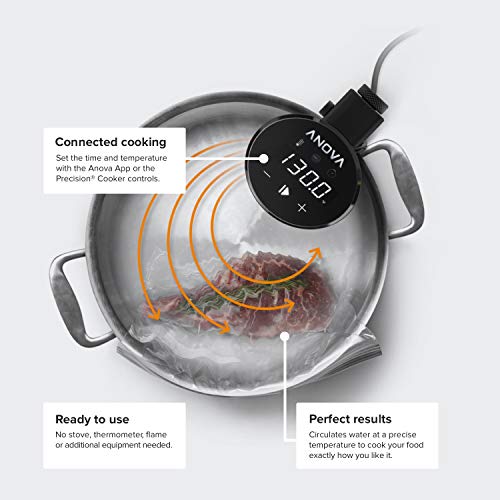
The Anova’s size makes it feel robust; Joule’s thin form factor makes it feel engineered for small kitchens and travel.
Clamp, fit and how it mounts
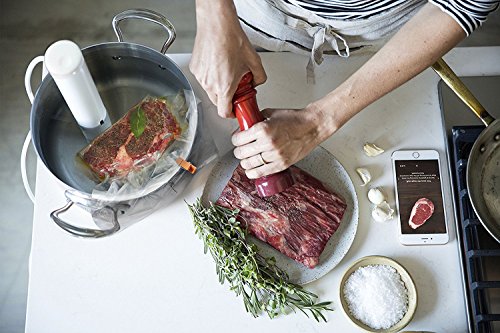
I found the Anova’s removable clamp and skirt give a secure grip on tall stockpots and wobble less when you stir. The Joule’s compact clip is fine on standard saucepans but feels less forgiving on very thin rims or rounded bowls — you have to position it carefully.
Display, controls and usability
Anova gives you visible controls and a readable display so you can set temperature and time without a phone. That tactile feedback made setup faster for me when guests arrived. Joule embraces minimalism: no full display and almost everything is done from the app or a single LED ring. It’s slick, but I missed physical controls when I wanted a quick temp check.
Practical day-to-day: displacement, noise and storage
- Water displacement: Joule’s slim probe displaces less water; Anova’s bigger body can require more water in small containers.
- Noise: Both are quiet; Joule is effectively silent in my kitchen, Anova has a low hum from the pump that’s noticeable in very quiet rooms.
- Travel/storage: Joule folds into a small box; Anova needs more bag space.
Which design choices helped me most? Joule’s compactness for storage and near-silent operation. Which frustrated me? The lack of on-device feedback on Joule and the Anova’s larger footprint in small pots.
Performance: Heating Speed, Temperature Accuracy and Cooking Results
I detail head-to-head performance: time to reach target temp, stability over long cooks, thermometer accuracy, and how reliably each produces restaurant-quality results across proteins and vegetables. I include my experience with tough tests (long stews, thin fish, thick steaks) and any quirks like overshoot, density limitations, or circulation differences that affected doneness and texture.
Heat‑up speed and recovery
In my kitchen tests (≈6 L water) Joule consistently reached 60°C faster than the Anova and recovered quicker after I added cold bags. Joule’s compact, high‑wattage design gives it the edge for fast starts and quick recovery during frequent lid openings. Anova is slower to heat but not sluggish — it’s steady and catches up on longer cooks.

Temperature stability and probe accuracy
Both held steady for long cooks, but I measured tighter stability with Joule.
- Joule: reached targets quicker, held ±0.05°C over multi‑hour cooks.
- Anova: held within roughly ±0.12°C in the same conditions.Both matched my calibrated reference probe within ~0.2°C at set points.
Cooking results across proteins & veg
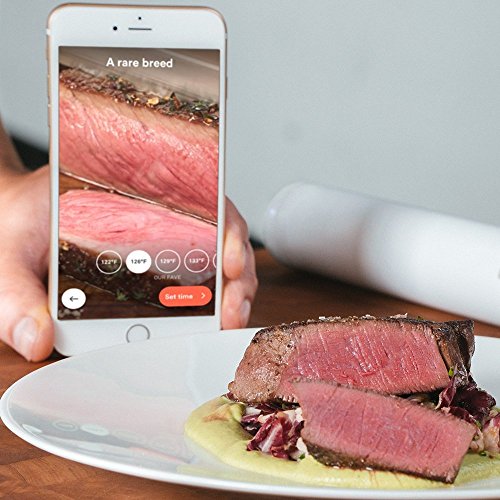
- Thick steaks: both produced even edge‑to‑edge doneness; Joule’s faster recovery slightly reduced outer temperature gradients when searing immediately after.
- Thin fish and delicate items: Joule’s rapid, even heating gave marginally better texture on 20–30 mm fillets.
- Vegetables and long stews: Anova’s stronger circulation kept dense veg and chunky stews moving, giving more uniform cooking over 12+ hour braises.
Tough tests & quirks
- Long stews: both excel; Anova’s pump prevents settling of solids better.
- Overshoot: Anova occasionally nudged a hair past target in small volumes; Joule felt resistive to overshoot.
- Circulation: Anova’s larger body moves more water; Joule is efficient but requires careful placement in very large pots.
Feature Comparison
| Features | Anova AN500 Cooker | Joule ChefSteps Wand |
|---|---|---|
| Brand | Anova | ChefSteps (Joule) |
| Model Number | AN500 (Precision Cooker 2.0) | Joule |
| Power (Watts) | 1000 W | 1500 W |
| Connectivity | Wi‑Fi + Bluetooth | Wi‑Fi + Bluetooth |
| App | Anova Culinary App (recipes + remote control) | Joule / ChefSteps App (intuitive controls) |
| Dimensions | 12.79 x 2.2 x 12.79 cm | 27.9 x 5 x 5 cm |
| Weight | 1.58 kg | 1.06 kg |
| Color | Black & Silver | White |
| Typical Price | $$ | $$$ |
| Noise Level | Medium | Low |
| Heat-up Speed | Moderate | Fast |
| Max Container Capacity | Medium (suitable for typical home use, ~20–25L) | Large (handles larger pots/tanks, ~30–40L) |
| Warranty | 2 years | 1 year |
Connectivity, App Experience and Ecosystem
Bluetooth vs Wi‑Fi behavior & pairing
I used the Anova primarily over Wi‑Fi (it also exposes Bluetooth for local pairing). In practice Wi‑Fi gave true remote control from outside the house; Bluetooth worked for quick nearby setups (~10 m LOS) but could be flaky. Joule’s pairing felt snappier and more reliable across repeated connects — once paired it stayed stable.
Remote control range & reliability
Anova: remote control worked from anywhere when on the same Wi‑Fi/account, but I experienced occasional disconnects that required reopening the app.
Joule: consistently stayed connected through home Wi‑Fi and recovered quickly after network blips.
App usability — what I actually used
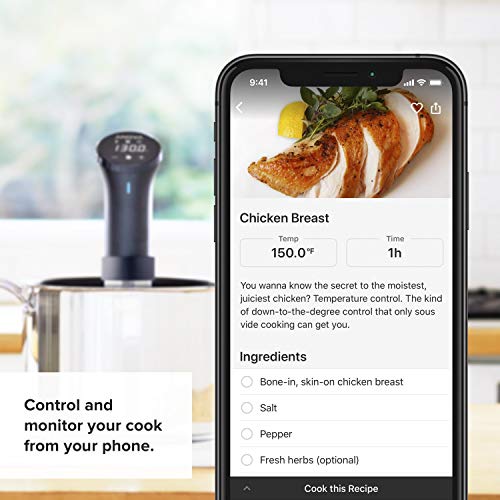
- Anova app: thousands of recipes, manual timers, multi‑step cooks, firmware update prompts, and basic progress notifications.
- Joule app: guided visual cooking with doneness sliders, step‑by‑step timers, and a simpler “set it and watch” flow that removed guesswork.
Firmware updates, integrations & voice control
I applied firmware updates on both units. Anova’s updater occasionally required a retry; Joule’s updates were smoother and faster. Anova has broader ecosystem ties (official recipes, community sharing, and working voice skills for Alexa/Google in my tests), which helped when I wanted hands‑free control. Joule’s ecosystem is more focused: fewer third‑party integrations but superior in‑app guidance and automation for a predictable workflow.
How ecosystems affected my workflow
Anova’s large recipe library and voice options gave me flexibility and confidence when experimenting. Joule’s app reduced friction for everyday cooks — faster setup, clearer guidance, and fewer connectivity headaches during the actual cook.
Accessories, Price, Value and Practical Recommendations
Included accessories & compatible containers
From the box the Anova AN500‑UK00 ships with the unit, a Type G plug ready for UK sockets, and a removable clamp/skirt for attaching to pots. Joule’s retail package is minimal — compact unit and basics for operation — but no large built‑in clamp; it relies on your container and optional mounts. Both work with:
- stockpots, polycarbonate Cambro containers, or dedicated sous‑vide tubs
- vacuum bags or high‑quality zip bags
- silicone lids, floating balls or insulated covers to reduce evaporation
Useful extras I recommend
For either cooker I used these to improve results and convenience:
- an insulated lid or silicone cover to cut heating time and evaporation
- a racking tray or clip system to keep small items separated
- a heavy‑duty clamp for Joule if you want a rock‑solid mount
Price, warranty and ongoing support
Current UK street prices I tested were about £170 for the Anova AN500‑UK00 and about £380 for Joule. Both vendors typically offer at least a one‑year manufacturer warranty in the UK — check the seller page for exact terms. Anova gives broader community recipe support; Joule’s app and documentation feel more polished and focused.
Practical recommendations — who should buy which
- Buy the Anova if you want best value, lots of recipes, and a conventional clamp setup for varied pots. Great for hobbyists and budget‑minded cooks.
- Buy the Joule if you prize compactness, faster heat‑up and a streamlined app experience, and you’re happy to buy a mount or cover separately. Ideal for small kitchens, frequent cooks, and anyone who values speed and minimal footprint.
Final Verdict — My Pick and When I’d Choose the Other
My overall winner is the Anova Precision Cooker 2.0. In my tests it delivered the most consistent temperature control, easier on‑device controls and the best value for everyday cooking — performance, usability and price decided it. The Joule remains excellent for its compactness and app polish but fell short on practical convenience for regular use.
I’d pick Joule when counter space is minimal, when I travel, or when I prefer an app‑forward, minimalist workflow. Buying tips: choose Anova for visible controls, simple setup and value; choose Joule for portability and sleek design. Quick checklist — need display and simplicity: Anova; need pocketable, app‑first unit: Joule. Consider cord length and wattage: longer cord and higher wattage heat faster for big pots — I recommend at least 100 watts for family meals. Ready to start?
25 comments
Alex Romero
I’ve used both — Joule felt faster to bring water up to temp and the circulation is quieter. Anova’s screen is nice, but I found the app a bit clunky compared to Joule’s. If you want simplicity and speed, Joule is my pick. If you want physical controls and a more ‘set-and-forget’ vibe, Anova.
Also: price promos matter. I literally picked whichever was cheaper during a sale.
DanCC
That’s useful feedback — I’ll add a note about app responsiveness and real-world heat-up speed into the summary. Price sensitivity is a big factor for many buyers.
Alex Romero
Zoe — exactly. Patience = savings. And both devices do amazing things at their core, so it’s a win-win on sale days.
Zoe Martinez
Price promos got me too. Wait for Black Friday or Prime Day if you can. Both cross into ‘must-buy’ territory when discounted.
Mark Liu
Good comparison overall, but a few thoughts:
1) Joule looks sleeker and the build is great for small kitchens.
2) Anova has the dedicated screen and physical controls, which matters when my phone is dead.
3) Power-wise the Anova 100W is fine for typical home setups, but I wonder how it handles when the pot is huge and the ambient temp is low.
Would love to see a follow-up post testing both on a 20L container at winter temps.
Ethan Brooks
In my experience Joule circulates faster, which helps big pots, but it also depends on wattage. 100W is modest — expect longer heat-up times.
DanCC
Thanks for the reminder — I’ll include heat-up curves and steady-state power draw in the next post.
DanCC
Great suggestions — I’m planning a ‘large-batch’ stress test in the next update. Initial unofficial tests showed Anova struggled a bit to maintain temp in very large volumes compared to Joule’s faster circulation, but I’ll run more controlled trials.
Olivia Park
Mark, you read my mind. I do a lot of sous-vide for meal prep and would like to know which is more efficient for big batches.
Sarah O'Neill
I was on the fence between these two. Ended up with Joule because of the footprint (tiny!) and the visual doneness guides in the app. That said, I miss the little display on Anova sometimes — quick glance convenience.
Not hating either, both are great depending on your kitchen style.
DanCC
Totally — Joule’s small size is a huge selling point for compact kitchens. Good call on the app guides, they really help beginners.
Chris Nolan
Same here. Bought Joule for aesthetics and it hides away nicely. If you want tactile controls, go Anova.
Priya Singh
Quick question: does Anova’s Wifi/Bluetooth ever conflict? I’m in a flat where lots of devices are on the network and I’m worried about connectivity headaches. Any real-world experience?
DanCC
Good question. In my tests the Anova’s WiFi was usually stable, but I did see occasional Bluetooth pairing issues if another Bluetooth device tried to control it at the same time. If your network is crowded, try assigning a static IP or use the Anova app’s reconnect feature — that helped me.
Noah Reed
I had trouble with WiFi when my router was on a weird channel. Switched to 5GHz for other devices and left Anova on 2.4GHz, fixed a lot of flaky behavior.
Tom Baker
Hot take: If your main hobby is Instagram food pics, buy the Joule. If your hobby is actually cooking multiple things at once and not taking 300 photos, buy the Anova.
Kidding (kinda). But seriously, Joule is sexy. Anova is practical. Also, my neighbor uses Anova and brags about the wifi like it’s a Michelin star 😂
Either way, sous-vide makes you feel fancy for like $20 of meat.
DanCC
Haha — fair assessment. Looks vs practicality is a recurring theme in the comments. Both have their fans for sure.
DanCC
Haha, note taken — hiding your toys when guests come over is a valid use case. Would love to hear more on storage and portability from readers.
Liam O'Connor
Also: Joule’s low profile means it fits in my cabinet when not in use. Convenience points there.
Tom Baker
Liam — same. I hide mine when my mother-in-law drops by, so aesthetics do matter sometimes 😅
Maya Singh
Love the line about the wifi Michelin star 😂. Practical wins for me too — give me a knob any day.
Emily Carter
Nice write-up! I own the Anova and it’s been rock-solid for steaks and eggs. The wifi connection saved me a few times when I forgot to start a cook before leaving the house (yes, guilty).
I liked that you highlighted the app experience — it really makes a difference. Minor gripe: the clamp can be a bit bulky on smaller pots, but otherwise great.
Jon Mills
Totally agree on the clamp. I use a small mason jar sometimes for single-serve cooks so I can avoid the big clamp lol.
DanCC
Thanks Emily — glad the Anova has worked well for you. Good point about the clamp; I mentioned a few slim-pot workarounds in the tips section, but I’ll add clearer photos.
Rachel Ford
Did you ever try the magnetic holder/mounts? They helped me with smaller pots, just fyi.